Give AI a better event brief
A useful draft starts with the details your team already knows.

Perspectives · Growth strategy
Build a campaign around the events you want to win, the evidence clients need, and the conversations your team can turn into bookings.
By Eventflai ·
An editorial framework for planning and reviewing campaigns.
Before choosing images or writing an ad, describe the business opportunity. “More leads” leaves too much unanswered. A venue filling weekday corporate dates needs a different conversation from a caterer building a wedding pipeline or a production company seeking repeat brand work. Name the buyer, the event format, the service area, and the kind of work your team can deliver well.
Turn that description into a short campaign brief. Include the capacity you want to sell, the dates or season that matter, the minimum scope worth pursuing, and the next step you can offer. Treat these as your planning assumptions, then validate them with the people who handle inquiries. The brief should reflect the work you want to book, not simply the most photogenic event in your archive.
An event company rarely sells a complete production through a single ad. The practical question is what a prospective client can usefully do next. A venue might invite an availability conversation. A caterer could offer a discussion of the event brief. A production team might show a relevant case study and invite the buyer to explore a similar challenge.
Keep the promise consistent across the ad, the destination, and the response from your team. If an ad introduces a corporate reception service, the visitor should find relevant work and a clear inquiry path, rather than having to reconstruct the offer from a general homepage. Avoid implying that a date, price, or package is confirmed before someone has checked it.
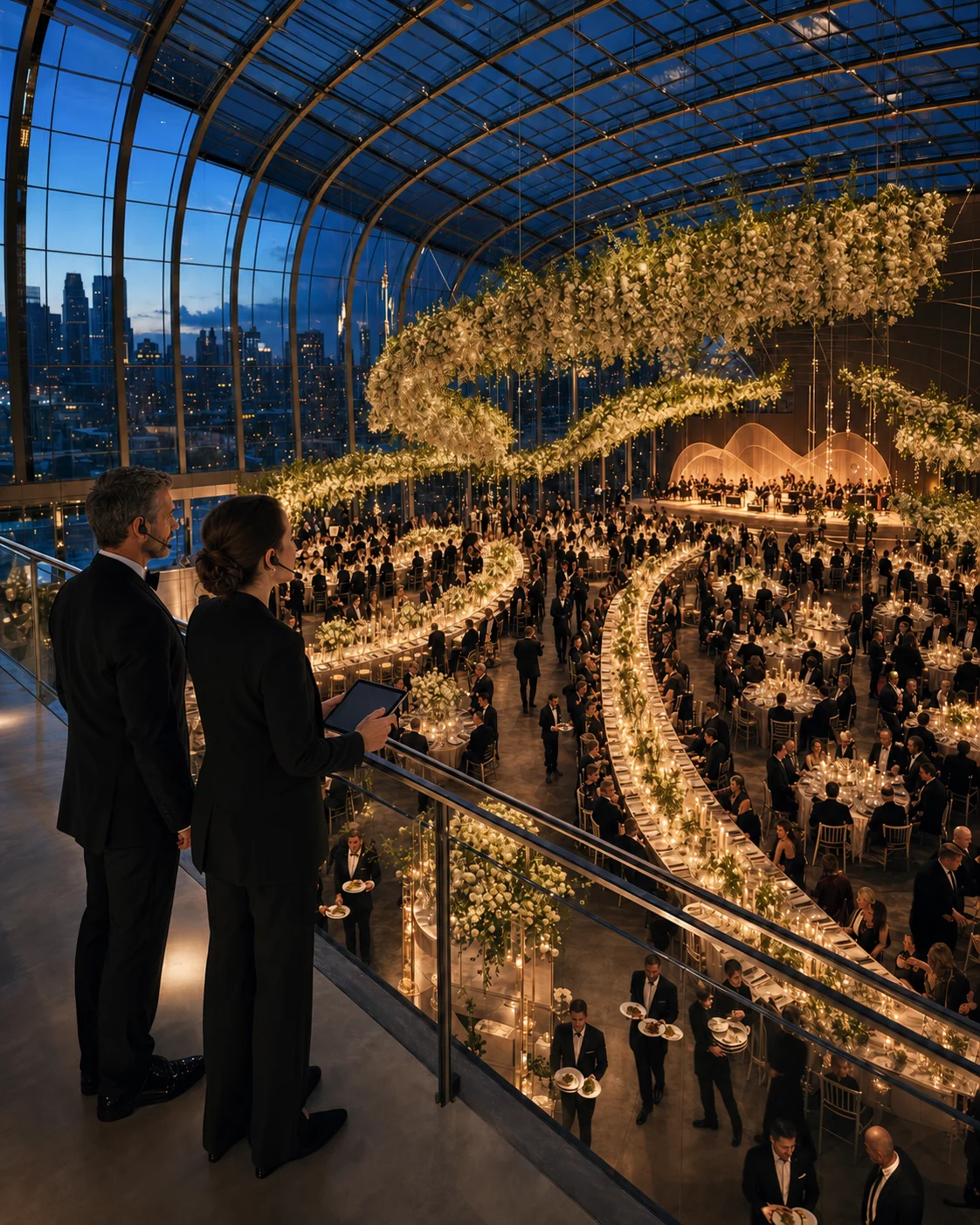
Beautiful photography earns attention, but context helps a buyer judge fit. Pair imagery with a concrete story: the kind of event, the challenge, and your team’s contribution. A room transformation can demonstrate production capability; a sequence of service moments can show how a catering team handles the guest experience. Use imagery you have permission to publish and retain the credits attached to it.
Build a few distinct creative hypotheses rather than changing many small details at once. One might lead with the finished setting, another with the planning problem, and another with the experience of working with your team. Write down what each is intended to communicate. These are ideas to test against your own audience, not a guarantee that any one approach will outperform the others.
Consider which details your team needs to decide whether it can help: event type, approximate date, location, guest count, and an outline of the brief. Ask for enough context to start a productive conversation, while leaving room for clients who are still exploring. Explain what happens after submission and who will respond.
Measure what happens beyond the form. Meta’s training describes using first-party CRM data with the Conversions API to support optimization toward lead quality. That is a platform capability to evaluate with your marketing and data teams; it is not an integration claimed for Eventflai. See Meta’s guidance on lead quality and CRM signals.
A cheap inquiry is not automatically a valuable opportunity. Keep a consistent record of which inquiries are reachable, suitable for your services, ready for a conversation, and ultimately booked. Agree on the meaning of each stage before comparing campaigns. An inquiry that is outside your geography should not be confused with a qualified client who is still deciding.
Review the campaign and the follow-up process together. If suitable prospects inquire but never receive a useful response, changing the creative alone may not address the problem. If many inquiries are unsuitable, revisit the offer and the information people see before submitting. Keep the time between inquiry and booking in view, so you do not compare a mature group of leads with one that has only just arrived.
End each review with a short record: what you tested, what the results can support, what remains uncertain, and what you will change. Decide in advance what your team can afford to test and what evidence it needs before expanding the effort. There is no universal budget or performance threshold that fits every event company.
Keep the campaign brief, approved imagery, captions, and sales observations connected. Eventflai’s content and gallery workflows can help prepare and organize the material your team works from. Campaign execution and measurement remain in your advertising and sales systems. The aim is a repeatable process in which each campaign teaches the team something useful about its buyers.
Practical workflows to support the strategy.
A useful draft starts with the details your team already knows.
Keep the story behind an image close enough to use.
Explore connected tools for your content, imagery, and event workflows.
Explore Eventflai